







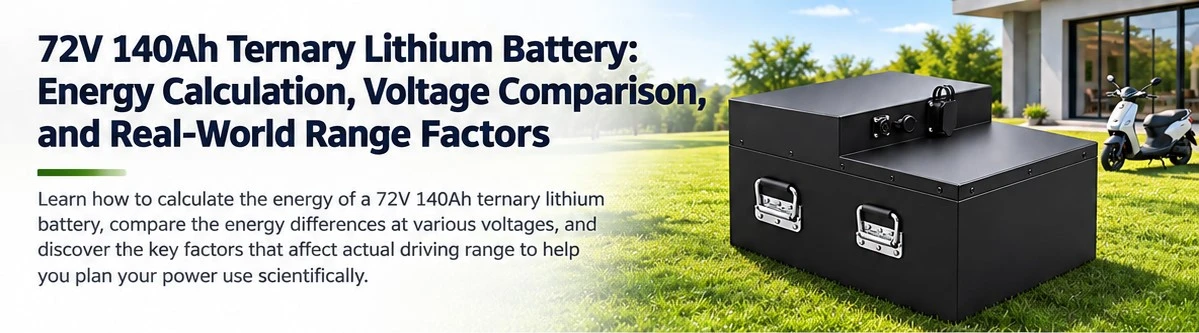
A 72V 140Ah lithium battery offers substantial energy storage for electric motorcycles, electric tricycles, utility vehicles, and other high-power electric applications. But how much energy does a 72V 140Ah battery actually store? And how does it compare with 48V and 60V battery systems?
In this guide, we explain how to calculate lithium battery capacity in kWh, compare the energy available at different system voltages, and examine the major factors that affect real-world battery runtime and driving range.
How Much Energy Does a 72V 140Ah Lithium Battery Store?
The basic battery energy calculation is straightforward.
The formula is:
Energy (Wh) = Voltage (V) × Capacity (Ah)
For a 72V 140Ah lithium battery:
72V × 140Ah = 10,080Wh
Since 1,000Wh equals 1kWh:
10,080Wh ÷ 1,000 = 10.08kWh
Therefore, a 72V 140Ah battery has a nominal energy capacity of approximately 10.08kWh when calculated using a nominal system voltage of 72V.
For perspective, 10.08kWh of theoretical energy could power a constant 100W electrical load for approximately:
10,080Wh ÷ 100W = 100.8 hours
This calculation is theoretical. Actual usable energy will normally be lower because of battery management limits, conversion losses, temperature, discharge rate, battery condition, and other operating factors.
Theoretical Capacity vs. Usable Battery Energy
Although the nominal capacity is 10.08kWh, users should not assume that every watt-hour will always be available.
A Battery Management System (BMS) helps protect lithium battery cells against conditions such as overcharging, excessive discharge, overcurrent, and abnormal temperatures. Depending on battery design and BMS settings, some capacity may effectively remain outside the normal operating range.
For example, if approximately 5%–10% of the nominal energy is unavailable because of operating limits, the usable energy would be approximately:
10.08kWh × 95% = 9.58kWh
or:
10.08kWh × 90% = 9.07kWh
That gives an estimated usable range of around 9.07–9.58kWh under this assumption.
However, the actual usable capacity should always be determined from the battery manufacturer's specifications, including its cell chemistry, BMS configuration, charge and discharge voltage limits, and recommended depth of discharge.
48V vs. 60V vs. 72V 140Ah Battery: What's the Difference?
When amp-hour capacity remains the same, increasing the nominal voltage increases the total stored energy.
| Battery System | Capacity | Nominal Energy | Energy in kWh |
|---|---|---|---|
| 48V | 140Ah | 6,720Wh | 6.72kWh |
| 60V | 140Ah | 8,400Wh | 8.40kWh |
| 72V | 140Ah | 10,080Wh | 10.08kWh |
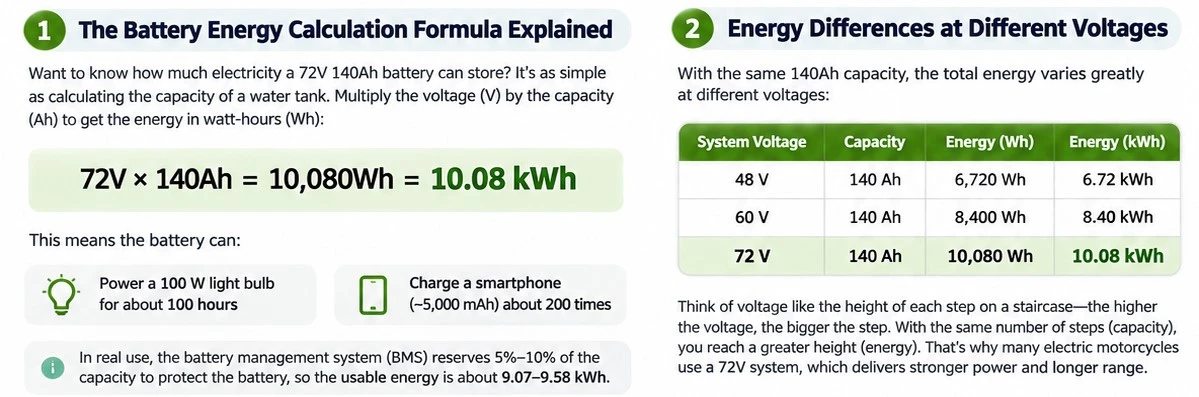
A 72V 140Ah lithium battery therefore stores about 50% more nominal energy than a 48V 140Ah battery, based on these nominal voltage values.
This is one reason higher-voltage battery systems are frequently considered for electric motorcycles, electric tricycles, utility vehicles, and other applications requiring substantial power.
However, higher battery voltage alone does not automatically guarantee longer driving range. Range also depends on battery energy, motor and controller efficiency, vehicle weight, speed, aerodynamics, terrain, tires, temperature, and driving conditions.
How Long Can a 72V 140Ah Battery Run an 800W Motor?
A simple theoretical runtime calculation can be made by dividing battery energy by load power:
Runtime (hours) = Battery Energy (Wh) ÷ Load Power (W)
For a 10,080Wh battery and a constant 800W load:
10,080Wh ÷ 800W = 12.6 hours
So, under ideal conditions, the theoretical runtime is approximately 12.6 hours.
This number should not be interpreted as the actual driving time of an electric motorcycle or electric tricycle. Vehicle motors do not normally consume a constant 800W while riding. Power demand continuously changes during acceleration, climbing, cruising, braking, and stopping.
If total real-world losses and operating limitations reduce the theoretical figure by 20%–30%, a simplified estimate would be approximately 8.8–10.1 hours.
For vehicle applications, however, calculating range in kilometers or miles requires knowing the vehicle's average energy consumption in Wh/km or Wh/mile.
What Factors Affect the Real-World Range of a 72V 140Ah Lithium Battery?
Battery capacity is only one part of the range equation. Several operating conditions can significantly change how far an electric vehicle travels on one charge.
1. Depth of Discharge (DoD)
Frequently discharging a battery to its lowest permitted state of charge may affect long-term battery life, depending on the cell chemistry and battery design.
Some users choose to maintain a reserve rather than routinely using the entire available capacity. The optimal charging and discharging strategy should follow the cell and battery manufacturer's recommendations.
2. Temperature
Lithium-ion battery performance is temperature-dependent. Low temperatures can temporarily reduce available capacity and increase internal resistance, while excessive heat can accelerate battery degradation.
The exact capacity loss at a given temperature varies considerably with cell chemistry, battery design, discharge rate, thermal management, and battery age. Therefore, fixed percentages should be treated as examples rather than universal specifications.
3. Acceleration and Riding Style
Frequent hard acceleration, high-speed riding, steep hill climbing, and heavy loads increase power demand.
A vehicle operated smoothly at moderate speeds will generally consume less energy than the same vehicle driven aggressively under otherwise similar conditions.
4. Battery Aging
Lithium batteries gradually lose usable capacity as they accumulate charge cycles and calendar age.
How quickly a battery degrades depends on factors such as:
Cell chemistry and quality
Operating temperature
Charge and discharge rates
Depth of discharge
Storage conditions
Charging habits
Battery management and thermal design
Instead of assuming that every battery will retain a specific percentage after two years, check the manufacturer's cycle-life specification and capacity-retention test conditions.
5. Vehicle Weight and Payload
A heavier electric motorcycle or tricycle generally requires more energy to accelerate and climb hills. Passenger weight, cargo, accessories, and the battery pack itself all contribute to total vehicle mass.
This factor can be especially important for electric cargo tricycles and commercial utility vehicles.
6. Terrain and Road Conditions
Flat roads usually require less energy than steep or continuously rolling terrain. Soft surfaces, poor pavement, and frequent stop-and-go operation can also increase consumption.
7. Motor and Controller Efficiency
Energy is lost as electricity travels from the battery through the controller and motor to the wheels. Motor efficiency also changes with speed, torque, and operating conditions.
For this reason, two electric vehicles equipped with the same 72V 140Ah battery pack can deliver very different driving ranges.
How to Estimate Electric Vehicle Range More Accurately
If you know the vehicle's average energy consumption, a more useful range estimate is:
Estimated Range = Usable Battery Energy ÷ Average Energy Consumption
For example, assume a 72V 140Ah battery provides approximately 9.5kWh of usable energy.
If a vehicle consumes an average of 60Wh/km:
9,500Wh ÷ 60Wh/km ≈ 158km
If consumption increases to 80Wh/km:
9,500Wh ÷ 80Wh/km ≈ 119km
This demonstrates why battery capacity alone cannot provide an exact range figure.
For customers comparing electric vehicle batteries, Wh/km or Wh/mile is one of the most useful figures for estimating practical range.
Is a 72V 140Ah Lithium Battery Right for Your Application?
With a nominal energy capacity of approximately 10.08kWh, a 72V 140Ah lithium battery can be suitable for applications requiring relatively high energy storage and power capability, including certain:
Electric motorcycles
Electric scooters
Electric tricycles
Cargo tricycles
Utility vehicles
Low-speed electric vehicles
Mobile and off-grid electrical equipment
Battery selection should not be based on voltage and Ah capacity alone. The battery's continuous discharge current, peak discharge current, BMS rating, cell chemistry, dimensions, weight, connector configuration, charger requirements, IP protection, cycle life, and compatibility with the motor controller should also be considered.

Frequently Asked Questions
How many kWh is a 72V 140Ah battery?
Using nominal values:
72V × 140Ah = 10,080Wh = 10.08kWh.
Therefore, a 72V 140Ah battery stores approximately 10.08kWh of nominal energy.
How many watts are in a 72V 140Ah battery?
Battery energy is measured in watt-hours rather than watts. A 72V 140Ah battery has approximately 10,080Wh of nominal stored energy.
Watts describe instantaneous power, while watt-hours describe energy capacity.
How long will a 72V 140Ah battery last?
Runtime depends on the electrical load. With an ideal constant 800W load:
10,080Wh ÷ 800W = 12.6 hours
Actual runtime will be lower or different depending on usable capacity, efficiency, temperature, load variation, battery condition, and other factors.
How far can a 72V 140Ah battery go?
There is no universal mileage figure because range depends heavily on the vehicle and operating conditions.
A useful estimate is:
Range = Usable Energy (Wh) ÷ Vehicle Consumption (Wh/km)
For example, with 9,500Wh of usable energy and consumption of 60Wh/km, estimated range would be approximately 158km (98 miles).
Is 72V better than 60V for an electric motorcycle?
Neither voltage is automatically better for every application. A 72V system can provide more energy than a 60V system when Ah capacity is identical, and higher voltage can be advantageous in higher-power systems. However, the battery voltage must match the motor controller, charger, BMS, and overall electrical system.

Conclusion
A 72V 140Ah lithium battery provides approximately 10.08kWh of nominal energy, making it a substantial energy source for electric motorcycles, electric tricycles, utility vehicles, and other electric mobility applications.
The basic calculation is simple:
72V × 140Ah = 10,080Wh = 10.08kWh
But nominal battery capacity should never be confused with guaranteed usable energy or vehicle range.
For a realistic estimate, consider usable depth of discharge, temperature, vehicle efficiency, average power consumption, riding habits, terrain, payload, motor efficiency, and battery aging.
Understanding these factors makes it much easier to compare battery systems accurately and choose the right lithium battery configuration for your electric vehicle or equipment.


