


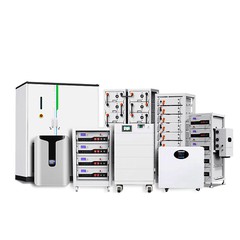


Liquid lithium battery
The four core components are: positive electrode, negative electrode, porous membrane, and liquid electrolyte.
Electrolyte: A flammable organic lithium salt solution in which lithium ions are completely immersed and conduct through the electrolyte; Separator: A plastic film that separates the positive and negative electrodes to prevent short circuits; Electrolyte content > 20%; All lithium iron phosphate, ternary, blade batteries, and cartridge batteries on the market are liquid lithium batteries.

Working principle
Charging: Lithium ions are released from the positive electrode, swim through the membrane in the liquid electrolyte, and embed themselves into the negative electrode;
Discharging: Lithium ions return to the positive electrode in the reverse direction, and electrons form a current in the external circuit.
Advantages
1. The technology is fully mature, the industrial chain is complete, and the mass production cost is the lowest;
2. The ion conduction resistance is low, and the fast charging and low temperature performance are stable;
3. The cycle life is stable (1000–2000 times), and the yield is high.
Shortcoming
1. The electrolyte is flammable and prone to leakage, thermal runaway, and fire due to puncture, compression, or high temperatures;
2. The energy density ceiling is approximately 250–300Wh/kg, limiting the potential for range improvement;
3. Lithium dendrites can easily puncture the separator, posing a risk of internal short circuits;
4. Electrolyte activity decreases at low temperatures, resulting in a significant reduction in range during winter.
Occupying over 95% of the market share in electric vehicles, energy storage, and mobile phone batteries, it will be the absolute mainstay in 2026.
Semi-solid batteries
The liquid electrolyte is significantly reduced to 5%–10%, with the remaining space filled with a solid ceramic/polymer electrolyte framework; the separator is retained, making it an enhanced and improved version of the liquid battery.
Advantages
1. Significantly reduced liquid content, making it less prone to explosion and ignition from puncture, compression, and fire, greatly improving safety;
2. Energy density of 350–400Wh/kg, 30%–50% higher than ordinary liquid form, easily achieving a range of 1000km+;
3. Compatible with high-capacity silicon-carbon anodes, suppressing lithium dendrite penetration;
Shortcoming
1. A small amount of liquid electrolyte remains, failing to completely eliminate the risk of fire;
2. The cost is 1.5–2 times higher than that of ordinary liquid batteries;
3. Impedance exists at the solid-liquid interface, resulting in weaker performance in extreme fast charging and ultra-low temperature applications compared to all-solid-state batteries.

All-solid-state lithium batteries
It uses only one solid electrolyte (oxide/sulfide/polymer) to simultaneously perform the dual functions of ion conduction and isolation of positive and negative electrodes, and contains no flammable organic solvents.
Three electrolytes
Sulfides: Their ionic conductivity is closest to that of liquid electrolytes, making them suitable for fast charging in vehicles; leading companies are focusing on this area.
Oxides (ceramics): They offer high stability and safety, but are brittle and have poor interfacial contact.
Polymers: They offer good flexibility, making them suitable for flexible batteries; they require high-temperature operation and are primarily used for energy storage.
Advantages
1. Ultimate Safety: No flammable liquids, no leakage, no thermal runaway, and no fire upon impact or puncture;
2. Theoretically, energy density can reach 500–700Wh/kg, supporting lithium metal anodes, effectively doubling battery life;
3. Longer cycle life, less low-temperature degradation, and supports 10-minute super-fast charging;
4. Smaller cell size, significant lightweight advantages, suitable for aviation and high-end electric vehicles.
Shortcoming
1. Poor adhesion between solids results in slow lithium-ion conduction;
2. Novel process: Requires ultra-dry, dust-free workshops, isostatic pressing, and dry electrodes, rendering almost all existing production lines obsolete and requiring huge investment;
3. Sulfides produce toxic gases when exposed to water, necessitating extremely stringent manufacturing environmental requirements;
4. Currently extremely high cost, unlikely to be affordable for the general public in the short term.
| Comparison Dimensions | liquid lithium battery | Semi-solid (mixed solid-liquid) | All-solid-state lithium batteries |
|---|---|---|---|
| Liquid electrolyte ratio | >20% | 5%–10% | ≤0.5% |
| diaphragm | Must be equipped | Preservation of diaphragm | Completely cancel |
| Energy density | 250–300Wh/kg | 350–400Wh/kg | 500+ Wh/kg |
| Security level | Generally flammable | Good quality, non-flammable | Top-tier, non-flammable, and free from thermal runaway. |
| Interface impedance | Low | medium | Extremely high |
| Mass production cost | lowest | Medium to high | Extremely high |
| Mass production cost | Mature | Upgrade 70% of existing equipment | New production line |
| Cycle life | 1000–2000 | 1500–2500 | Theoretical 3000 times + |


