


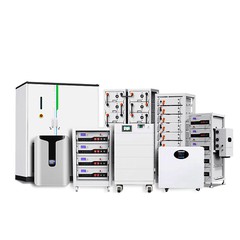


Lithium battery production is a systematic engineering process requiring high precision and cleanliness. It revolves around five core stages: "Material Purification → Electrode Formation → Cell Assembly → Chemical Activation → Quality Verification." Throughout the entire process, humidity, impurities, and process parameters must be strictly controlled to ensure battery safety, capacity, and cycle life. The well-known Tesla electric vehicles, for instance, use battery packs composed of 18650 lithium-ion cells connected in series and parallel. With the rising popularity of new energy vehicles, the power battery industry has become increasingly prominent!
Core Materials:
Cathode (Determines energy density): Lithium Iron Phosphate (LFP), Ternary materials (NCM/NCA, e.g., Lithium Nickel Cobalt Manganese Oxide).
Anode (Determines cycle life): Natural Graphite / Artificial Graphite (mainstream), Silicon-Carbon Composite materials (direction for high-capacity upgrades).
Electrolyte (Ion transport medium): Lithium Hexafluorophosphate (LiPF₆) + Carbonate-based organic solvents (e.g., EC/DMC).
Separator (Prevents short circuits): Polypropylene (PP) / Polyethylene (PE) composite membrane (Porosity 40%-50%).
Cell
Depending on the application scenario (EV / Energy Storage / Consumer Electronics), cells are categorized into Cylindrical, Prismatic, and Pouch types, with slight variations in assembly processes:
|
Cell Type |
Assembly Method |
Representative Products |
|
Cylindrical |
Winding (Electrodes + separator wound into a cylinder) |
Tesla 18650/4680, Panasonic 21700 |
|
Prismatic |
Stacking (Electrodes + separator stacked layer by layer) |
CATL Ternary Lithium Prismatic Battery (for EV) |
|
Pouch |
Stacking (Packaged in aluminum-plastic film) |
Mobile Phone / Laptop Batteries |
21-Step Operational Process Flow:
Step 1: Anode Slurry Mixing
Step 2: Cathode Slurry Mixing
Step 3: Coating
Step 4: Calendering
Step 5: Slitting
Step 6: Drying
Step 7: Winding
Step 8: Case Insertion
Step 9: Spot Welding
Step 10: Baking
Step 11: Electrolyte Filling
Step 12: Cap Welding
Step 13: Cleaning
Step 14: Dry Storage
Step 15: Alignment Inspection
Step 16: Case Laser Marking
Step 17: Formation
Step 18: OCV Measurement
Step 19: Ambient Temperature Storage
Step 20: Capacity Grading
Step 21: Final Inspection
100% full inspection is conducted, with non-conforming products directly removed. Core inspection items are as follows:
|
Inspection Type |
Standard Requirement |
Purpose |
|
Capacity Test |
Actual Capacity ≥ 95% of Rated Capacity (0.5C charge/discharge) |
Ensures range compliance |
|
Cycle Life Test |
Capacity Retention ≥ 80% after 1000 cycles |
Verifies durability |
|
Safety Test |
No fire/explosion during Overcharge (1.2x voltage), Short Circuit, Thermal Shock (85°C) |
Compliance with UL 9540A / IEC 62133 Standards |
|
Appearance / Dimension Inspection |
No scratches, swelling; Dimensional tolerance ±0.2mm |
Ensures compatibility with downstream assembly |
|
Internal Resistance Test |
Internal Resistance ≤ 50mΩ (Polymer Pouch Cell) |
Guarantees charge/discharge efficiency |


