


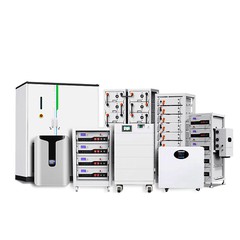


LiFePO4 Battery Voltage at a Glance
A single LiFePO4 cell is commonly rated at approximately 3.2V nominal. To create a higher-voltage battery pack, multiple cells are connected in series so their voltages add together.
For example, four 3.2V cells connected in series create a nominal pack voltage of:
3.2V × 4 = 12.8V
This is why a battery sold as a "12V LiFePO4 battery" is commonly 12.8V nominal rather than exactly 12.0V.
LiFePO4 Battery Voltage Chart
| Marketed System | Common Configuration | Typical Nominal Voltage | Typical Maximum Charge Voltage* |
|---|---|---|---|
| 12V | 4S | 12.8V | 14.6V |
| 24V | 8S | 25.6V | 29.2V |
| 36V | 12S | 38.4V | 43.8V |
| 48V | 16S | 51.2V | 58.4V |
Voltage consistency across every cell in a pack is critical for long life and safety. Even small differences in cell voltage will amplify over charge-discharge cycles, creating imbalance that reduces usable capacity and shortens pack life. At Greatech, our in-house cell testing lab sorts and matches Grade A cells to within ±15mV before assembly to maximize pack longevity.
For a deeper technical breakdown of LiFePO4 electrochemistry, refer to this independent guide to LiFePO4 battery voltage characteristicsfrom Battery University.

What Does LiFePO4 Battery Voltage Mean?
At the core of every LiFePO4 system is the individual 3.2V nominal cell. This voltage comes directly from the electrochemical potential of the lithium iron phosphate cathode, and it defines the entire battery's operating characteristics.
A single LiFePO4 cell has a characteristically flat discharge plateau, meaning it holds near-constant voltage across most of its capacity. This is very different from lithium nickel manganese cobalt (NMC) cells, which have a higher 3.7V nominal voltage but a steeper voltage drop as they discharge.

Key Voltage Terms
| Term | Meaning | Why It Matters |
|---|---|---|
| Nominal Voltage | Reference voltage used to describe a battery | System selection |
| Charge Voltage | Voltage applied during charging | Charger compatibility |
| Resting Voltage | Voltage measured with little or no load | Diagnostics |
| Working Voltage | Actual voltage under operating load | System performance |
| Cut-Off Voltage | Protection or operating limit | Battery protection |
A good engineering specification should distinguish between these values rather than referring simply to "battery voltage."
How Series Cells Determine LiFePO4 Pack Voltage
Battery systems increase total voltage by connecting individual cells in series. In a series configuration, the positive terminal of one cell connects to the negative terminal of the next. This adds up the voltage of each cell while keeping the total capacity (Ah) the same as a single cell.
The basic formula is:
Pack Voltage = Cell Voltage × Number of Series Cells
3.2V × 4 cells = 12.8V nominal
At a 3.65V-per-cell upper charge reference:
3.65V × 4 cells = 14.6V
Common Series Configurations
| Configuration | Cell Nominal Voltage | Series Cells | Pack Nominal Voltage |
|---|---|---|---|
| 4S | 3.2V | 4 | 12.8V |
| 8S | 3.2V | 8 | 25.6V |
| 12S | 3.2V | 12 | 38.4V |
| 16S | 3.2V | 16 | 51.2V |
Series connections increase voltage.
Parallel connections increase capacity and current capability, while nominal voltage remains approximately the same.
For example:
4 cells in series → approximately 12.8V
8 cells in series → approximately 25.6V
16 cells in series → approximately 51.2V
For example, if identical cells are used:
4S1P = four cells in series, one parallel string
4S2P = four series groups with two cells in each parallel group
16S4P = 16 series groups, four cells per parallel group
If an individual cell has a capacity of 100Ah, a 16S1P battery may be approximately 51.2V 100Ah. A 16S2P system using the same cells may be approximately 51.2V 200Ah.
Greatech describes its manufacturing facilities as including automated cell sorting, welding, PACK assembly, BMS testing, charge-discharge testing and aging equipment, which are all relevant to controlled battery-pack production. You can review the company's battery production equipment and PACK manufacturing capabilities.
12V, 24V, 36V and 48V LiFePO4 Systems Compared
Battery systems increase total voltage by connecting individual cells in series. In a series configuration, the positive terminal of one cell connects to the negative terminal of the next. This adds up the voltage of each cell while keeping the total capacity (Ah) the same as a single cell.
This series cell principle is how all standard LiFePO4 system voltages are built. Because each cell is 3.2V nominal, total system voltage is simply 3.2V multiplied by the number of cells in series.
12V LiFePO4 System
A typical 12V-class LFP pack uses four cells in series.
The common 12V LFP voltage values are:
Configuration: 4S
Nominal voltage: approximately 12.8V
4 cells in series (4S) = 12.8V nominal
12V-class batteries are frequently used in:
RV electrical systems,
marine auxiliary power,
portable power systems,
backup equipment,
small solar systems,
lead-acid replacement projects.
24V LiFePO4 System
A common 24V LiFePO4 pack uses an 8S configuration.
Typical reference values are:
Configuration: 8S
Nominal voltage: approximately 25.6V
8 cells in series (8S) = 25.6V nominal
Typical maximum charge reference: approximately 29.2V
36V LiFePO4 System
A common 36V-class LiFePO4 architecture is 12S.
Typical values are:
Configuration: 12S
Nominal voltage: approximately 38.4V
12 cells in series (12S) = 38.4V nominal
Typical upper charge reference: approximately 43.8V
48V LiFePO4 System
Many 48V-class LiFePO4 batteries use 16 cells in series.
Typical 48V LFP voltage values are:
Configuration: 16S
Nominal voltage: approximately 51.2V
16 cells in series (16S) = 51.2V nominal
Typical upper charge reference: approximately 58.4V
Greatech's published energy-storageproduct information includes LiFePO4-based systems with higher series voltages for commercial-scale applications, demonstrating how the same series-cell principle continues beyond 12V–48V packs.
Voltage System Comparison
| System Class | Common Configuration | Nominal Voltage | Typical Maximum Charge* | Example Applications |
|---|---|---|---|---|
| 12V | 4S | 12.8V | 14.6V | RV, marine, portable power |
| 24V | 8S | 25.6V | 29.2V | Solar, industrial equipment |
| 36V | 12S | 38.4V | 43.8V | Mobility, machinery |
| 48V | 16S | 51.2V | 58.4V | ESS, telecom, higher-power systems |

LiFePO4 Charging Voltage, Resting Voltage and Low-Voltage Limits
For this reason, any useful LiFePO4 battery voltage chart should identify the operating condition rather than provide one unexplained number.
Charging Voltage
During charging, pack voltage rises as the charger supplies current.
The BMS may monitor individual cell voltage and interrupt charging if a cell reaches a programmed high-voltage threshold. Depending on BMS design, cell balancing may also occur near the upper portion of the charge cycle.
A 4S pack, for example, should not be charged using settings intended for an 8S or 16S pack.
Resting Voltage
After charging or discharging stops, battery voltage can change as the cells relax toward a resting condition.
Voltage Under Load
A battery may show a healthy resting voltage but drop significantly when supplying a large current.
The BMS may shut down the battery if the voltage of one or more cells falls below its configured protection threshold.
Do Not Use Generic Cut-Off Numbers Blindly
Different cells and battery packs can use different limits.

LiFePO4 Battery Voltage vs Lead-Acid Battery Voltage
A typical LiFePO4 cell is approximately 3.2V nominal.
Four cells in series produce:
4 × 3.2V = 12.8V
A traditional 12V lead-acid battery is built from six approximately 2V electrochemical cells.
Both can therefore be described as "12V-class" systems while having different voltage curves and charging requirements.
Discharge Behavior Is Different
LiFePO4 chemistry generally maintains a comparatively flat voltage profile through a large portion of its usable capacity.
This means equipment that estimates capacity from voltage alone may behave differently after switching battery chemistry.
How to Choose Between 12V, 24V, 36V and 48V LiFePO4 Systems
There is no single voltage that is automatically best.
The correct system voltage depends on the electrical load, equipment architecture, current requirements and installation constraints.
1. Start With the Equipment Voltage
The battery must be compatible with the voltage range accepted by the equipment.
Check:
motor controller limits,
inverter input range,
DC/DC converter input,
charger specifications,
BMS architecture,
auxiliary electronics.
Never choose the battery voltage independently of the equipment it will power.
2. Calculate Power and Current
The basic electrical relationship is:
Power = Voltage × Current
Rearranged:
Current = Power ÷ Voltage
Consider a simplified 2,400W load.
At 12V:
2,400W ÷ 12V ≈ 200A
At 48V:
2,400W ÷ 48V ≈ 50A
3. Check Peak Current
The battery must support:
continuous discharge current,
peak discharge current,
peak duration,
temperature conditions,
voltage sag limits.
4. Consider Runtime
Battery energy can be estimated using:
Energy (Wh) = Nominal Voltage × Capacity (Ah)
For example:
25.6V × 100Ah = 2,560Wh
Two battery systems can have different voltage and Ah ratings while storing similar amounts of energy.
5. Match the BMS
The BMS must support the correct number of series cells.
An 8S BMS is not interchangeable with a 16S BMS simply because both are used with LiFePO4 chemistry.
How to Measure and Troubleshoot LiFePO4 Battery Voltage
Voltage measurement can help diagnose a battery system, but the measurement must be taken safely and interpreted in context.
Step 1: Use a Suitable Multimeter
Use a properly rated digital multimeter and select the correct DC voltage range.
Confirm that the instrument, probes and test method are appropriate for the battery voltage involved.
Step 2: Measure Pack Voltage
Measure across the pack's designated positive and negative output terminals.
Compare the result with:
expected system voltage,
state of charge,
BMS status,
charger condition.
Step 3: Compare Resting and Loaded Voltage
A useful diagnostic process is to compare:
voltage with no significant load,
voltage while the equipment is operating.
A large drop under load may point to excessive current demand, poor connections, low SOC or increased internal resistance.
Step 4: Review Cell-Level Voltage When Appropriate
In serviceable systems designed for qualified technicians, individual series cells or series groups can be compared.
A significant difference between one series group and the others may indicate imbalance or another condition requiring further investigation.
Do not open or probe sealed, high-energy battery packs unless you are trained and the product is designed for service access.
Common Symptoms
| Observation | Possible Cause | Recommended Check |
|---|---|---|
| Pack voltage lower than expected | Low SOC or protection state | Charger and BMS |
| Voltage falls quickly under load | High current or high resistance | Load current and connections |
| One series group differs noticeably | Cell imbalance or cell issue | Cell-group measurements |
| Battery does not charge | Charger, wiring or BMS issue | System specifications |
| Battery shuts down under acceleration | Peak-current demand | BMS and pack current rating |
If abnormal cell differences remain after proper charging and balancing, continued operation should be evaluated according to the manufacturer's service guidance.
For technical inquiries, use Greatech's battery technical support and contact page.

Frequently Asked Questions About LiFePO4 Battery Voltage
What is the nominal voltage of one LiFePO4 cell?
A LiFePO4 cell is commonly rated at approximately 3.2V nominal. Actual voltage varies during charging, rest and discharge.
What is the voltage of a fully charged 12V LiFePO4 battery?
For a common 4S pack using 3.65V as the cell-level charge limit, the upper charge voltage is approximately 14.6V.
The exact charging specification should always come from the battery manufacturer.
Why is a 12V LiFePO4 battery rated at 12.8V?
A typical 12V-class LiFePO4 battery uses four 3.2V cells in series:
4 × 3.2V = 12.8V
"12V" is therefore a system-class description rather than the precise nominal voltage.
How many LiFePO4 cells are needed for a 24V battery?
A common 24V-class LFP battery uses 8 cells in series, resulting in approximately:
8 × 3.2V = 25.6V nominal
How many cells are commonly used in a 48V LiFePO4 battery?
A common configuration is 16S, or 16 cells in series.
Using 3.2V nominal cells:
16 × 3.2V = 51.2V nominal
Why is a 48V battery often rated at 51.2V?
Because "48V" commonly refers to the system class.
A 16S LiFePO4 configuration produces approximately 51.2V nominal, while the equipment is designed around the battery's actual operating range.
Can I use a lead-acid charger for a LiFePO4 battery?
Only if the charger profile is explicitly compatible with the LiFePO4 battery manufacturer's requirements.
Do not assume compatibility from nominal voltage alone.
Can voltage accurately show the state of charge?
Only approximately.
LiFePO4 batteries have a relatively flat discharge-voltage profile through much of their capacity range, so an appropriately configured BMS or coulomb-counting system can provide more useful SOC estimation than voltage alone.
What happens if one cell group has a different voltage?
A meaningful difference can indicate imbalance, inconsistent capacity, connection problems or another battery condition.
The BMS may limit charging or discharging when one cell reaches a protection threshold before the others.
Should I choose 12V, 24V or 48V?
Choose based on the equipment operating range, power, current, cable design, charger, BMS and installation requirements.
Higher voltage can reduce current for a given power demand, but it is not automatically the right choice for every project.
Need a Custom LiFePO4 Battery Pack? Talk to Greatech
Choosing the right battery requires more than selecting a voltage label.
For an OEM or industrial project, the complete specification should normally include:
| Project Parameter | Information to Provide |
|---|---|
| Nominal Voltage | e.g. 12.8V, 25.6V, 38.4V, 51.2V |
| Capacity | Ah or Wh |
| Continuous Current | A |
| Peak Current | A and duration |
| Physical Size | Length × width × height |
| Application | ESS, mobility, UAV, industrial equipment, etc. |
| Communication | CAN, RS485 or project-specific |
| Connector | Required connector type |
| Operating Temperature | Project requirement |
| Certification | Target market/application requirement |
Request a Custom Battery Quote from Greatech
Final Takeaway
The most important concept is simple: LiFePO4 system voltage is determined primarily by the number of cells connected in series.
A common 3.2V nominal cell produces approximately:
4S = 12.8V
8S = 25.6V
12S = 38.4V
16S = 51.2V
However, nominal voltage is only one part of battery selection. Charge voltage, discharge limits, BMS settings, current capability, equipment compatibility, temperature and application requirements must all be considered together.
For buyers, engineers and system integrators, the safest approach is to use voltage charts as an orientation tool and use the actual cell, pack, charger and equipment specifications for final engineering decisions.
References and Safety Resources
For project-specific compliance requirements, applicable standards depend on the intended market and application. UL Solutions identifies standards such as UL 1973, IEC 62619, and other battery-specific standards across stationary, industrial and transportation use cases.
Lithium batteries intended for transport are also addressed by UN Manual of Tests and Criteria, Subsection 38.3.
Technical Disclaimer: This article provides general educational information and is not a substitute for the battery manufacturer's datasheet, BMS specification, charger manual, electrical engineering review or applicable safety and certification requirements.


