


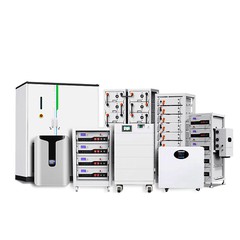


The fundamental parameters of lithium batteries are the core basis for evaluating their performance, applicable scenarios, and safe use. Different parameters directly affect the battery's range, charge/discharge efficiency, lifespan, and application compatibility. The following details the core fundamental parameters of lithium batteries in three main categories: electrical performance parameters, lifespan and stability parameters, and environmental adaptability parameters.

1. Voltage-related parameters
Voltage is the "power level" of a lithium battery, directly affecting device compatibility (e.g., mobile phone batteries cannot be used in electric vehicles). It includes three key voltage values:
| Parameter name | definition | unit | Core meaning | Typical example |
|
Nominal Voltage |
The average operating voltage of a battery during normal charging and discharging is also the voltage indicated on the battery model (e.g., "3.7V lithium battery"). |
V |
Determining the power supply compatibility of a device (the device must be compatible with the nominal voltage) is one of the core criteria for battery classification. | Ternary lithium: 3.7V; Lithium iron phosphate: 3.2V; Lithium polymer: 3.7V |
|
Charge Cut-off Voltage |
Exceeding the maximum permissible voltage during battery charging can lead to electrolyte decomposition, bulging, or even fire. |
V |
Controlling charging safety (the charger must be precisely matched to this voltage) is the core threshold of "overcharge protection". | Ternary lithium: 4.2V (standard) / 4.35V (high capacity); Lithium iron phosphate: 3.65V |
|
Discharge Cut-off Voltage |
The minimum allowable voltage for battery discharge; below this voltage will lead to lithium deposition on the negative electrode and permanent capacity decay. |
V |
Controlling discharge safety (the equipment must stop discharging before this voltage) is the core threshold of "over-discharge protection". | Ternary lithium: 2.75V; Lithium iron phosphate: 2.5V |
2. Capacity-Related Parameters
Capacity refers to the "energy storage capacity" of a lithium battery, which directly determines the device's battery life. It's important to distinguish between "nominal capacity" and "actual capacity"
| Parameter name | definition | unit | Influencing factors | Typical example |
|
Rated Capacity |
The "rated storage capacity" labeled by battery manufacturers under standard conditions (25℃, 0.2C discharge to cutoff voltage). |
mAh/ Ah |
The manufacturer's promised basic battery life is 1Ah = 1000mAh (e.g., a 1000mAh battery can last for 10 hours with a 100mA current). | Mobile phone batteries: 3000-5000mAh; Electric vehicle batteries: 50-200Ah |
|
Actual Capacity |
The actual energy storage capacity of the battery under real-world usage conditions (such as low temperature and high-rate discharge). |
mAh/Ah |
Affected by temperature (low temperature derating), discharge rate (high rate derating), and cycle count (aging derating). | A battery nominally rated at 5000mAh may only have 3500mAh capacity at -10℃. |
|
Energy Density |
The energy stored per unit mass/volume of a battery is categorized into "gravimetric energy density" and "volume energy density". |
Wh/kg,Wh/L |
The factors that determine the "lightweight" and "miniaturization" of a device (such as the range of an electric vehicle and the thickness of a mobile phone) | Ternary lithium: 200-300Wh/kg; Lithium iron phosphate: 150-200Wh/kg |
3. Charge/Discharge Rate (C-rate)
The rate is the "charge and discharge speed" of a lithium battery, represented by "C". It directly affects charging efficiency and discharging power (such as the requirements of fast charging and high-power devices).
• Definition: 1C = Current corresponding to the rated capacity of the battery (e.g., for a 1000mAh battery, 1C current = 1000mA; for a 200Ah battery, 1C current = 200A).
• Classification:
• Charge C-rate: For example, "1C charging" = fully charged in 1 hour; "2C charging" = fully charged in 30 minutes (charger required).
• Discharge C-rate: For example, "0.5C discharging" = fully discharged in 2 hours (low-power devices, such as mobile phones); "10C discharging" = fully discharged in 6 minutes (high-power devices, such as drones and power tools).
• Note: High-rate charging and discharging will lead to increased battery heat generation, shortened lifespan, and reduced actual capacity (e.g., the actual capacity of 10C discharge may only be 70% of the nominal capacity).
4. Internal Resistance
Internal resistance is the sum of the resistances of the internal materials (electrodes, electrolyte, separator) of a lithium battery, and its unit is milliohms (mΩ).
• Key Impacts:
a. Heat Generation: The higher the current, the more heat is generated by internal resistance (Q=I²Rt). High internal resistance batteries are prone to overheating during fast charging.
b. Voltage Drop: During discharge, internal resistance leads to a decrease in actual output voltage (actual voltage = nominal voltage - I × internal resistance). High internal resistance batteries have poor load-carrying capacity (e.g., sudden power loss while playing games on a mobile phone).
c. Lifespan: Internal resistance increases with the number of cycles (material aging). When the internal resistance exceeds a threshold, the battery cannot be used normally.
Typical Values: Small lithium batteries (mobile phones, earphones) have an internal resistance of approximately 50-200mΩ; large power batteries (electric vehicles) have an internal resistance of approximately 1-10mΩ.
II. Lifetime and Stability Parameters
These parameters determine the "durability" of lithium batteries, which directly affects usage costs (such as the replacement cycle of electric vehicle batteries).
5. Cycle Life
• Definition: The number of cycles a battery completes after a full charge-discharge cycle (from the charging cutoff voltage to the discharging cutoff voltage) when its capacity decays to 80% of its nominal capacity (industry standard).
• Key Influencing Factors:
• Charge/Discharge Rate: Low rates (0.2C-1C) result in longer cycle life, while high rates (above 5C) result in shorter lifespan.
• Temperature: 25-40℃ is the optimal cycling temperature. Low temperatures (<0℃) or high temperatures (>60℃) accelerate aging.
Depth of Charge (DOD): Shallow charge and discharge (e.g., charging to 80% and discharging to 20%) can significantly extend lifespan (e.g., ternary lithium batteries can achieve over 2000 shallow cycles and approximately 800-1200 full cycles).
• Typical examples:
• Mobile phone lithium batteries: 500-1000 cycles (full charge and discharge).
• Electric vehicle lithium iron phosphate batteries: 1500-3000 cycles (full charge and discharge).
6. Self-Discharge Rate
• Definition: The rate at which a battery naturally loses charge due to internal chemical reactions when it is not in use, usually calculated as a "percentage loss per month".
• Core Advantage: Lithium-ion batteries have a significantly lower self-discharge rate than traditional nickel-cadmium/nickel-metal hydride batteries (nickel-metal hydride batteries have a monthly self-discharge rate of approximately 20%-30%).
Typical Value: At normal temperatures (25°C), the monthly self-discharge rate of lithium-ion batteries is approximately 2%-5%; increased storage temperatures (e.g., above 40°C) will lead to an increase in the self-discharge rate.
6.1. Memory Effect
• Definition: The phenomenon where a battery appears to have reduced capacity due to being charged before it is fully discharged (common in nickel-cadmium batteries).
• Lithium-ion battery characteristics: Essentially no memory effect; can be charged whenever needed (no need to fully discharge before recharging), but prolonged storage at full charge (such as leaving a battery uncharged after charging to 100%) will accelerate aging.
7. Environmental Adaptability Parameters
These parameters determine the "applicable scenarios" of lithium batteries, especially their safety and stability in extreme environments.
7.1. Operating Temperature Range
• Definition: The temperature range within which the battery can be normally charged and discharged. Exceeding this range will lead to performance degradation or safety risks.
• Typical Range (Different Types of Lithium-ion Batteries):
| Battery Type | Normal discharge temperature | Normal charging temperature | Extreme temperature effects |
| ternary lithium battery |
-20℃ ~ 60℃ |
0℃ ~ 45℃ |
<-20℃ discharge capacity drops sharply;> 60℃ prone to bulging |
| Lithium iron phosphate batteries |
-30℃ ~ 60℃ |
0℃ ~ 50℃ |
It outperforms ternary lithium batteries at low temperatures and is more stable at high temperatures. |
| Lithium polymer batteries |
-10℃ ~ 50℃ |
0℃ ~ 40℃ |
Poor performance at low temperatures and prone to leakage at high temperatures. |
8. Storage Temperature Range
• Definition: The safe temperature range for long-term battery storage, affecting capacity retention after storage.
• Recommended Range:
• Short-term storage (within 1 month): 0℃ ~ 35℃, maintaining a charge level of 30%-50%.
• Long-term storage (more than 3 months): -20℃ ~ 25℃, maintaining a charge level of 30%-40% (avoid storing fully charged or completely discharged batteries).
9. Comparison of Core Parameters of Different Types of Lithium Batteries
The mainstream lithium batteries on the market are divided into three categories: ternary lithium, lithium iron phosphate, and lithium polymer. The differences in their parameters directly determine the applicable scenarios.:
| parameter |
ternary lithium battery(Li-NCM/LCO) |
Lithium iron phosphate batteries(LiFePO4) |
Lithium polymer batteries(Li-Polymer) |
| nominal voltage |
3.7V |
3.2V |
3.7V |
| Energy density |
high(200-300Wh/kg) |
middle(150-200Wh/kg) |
middle(180-250Wh/kg) |
| Cycle life |
middle(800-1200 life) |
high(1500-3000 life) |
middle(500-1000 life) |
| Low temperature performance |
better(-20℃ Dischargeable) |
generally(It can discharge at -30℃, but the capacity decreases significantly.) |
Poor(Capacity drops sharply below -10℃) |
| Security |
generally(High temperature can easily lead to thermal runaway) |
high(It has good thermal stability and is not easy to ignite.) |
generally (Prone to leakage, requires soft packaging for protection) |
| Applicable Scenarios | Mobile phones, laptops, high-end electric vehicles | Electric vehicles, energy storage, power tools | Ultra-thin devices (such as headphones and smartwatches) |


