







Hey there! As a 4S battery supplier, I often get asked about the discharge rate of a 4S battery. So, I thought I'd break it down for you in this blog post.

First off, let's understand what a 4S battery is. The "4S" refers to the number of cells connected in series within the battery pack. Each cell in a lithium - polymer (LiPo) battery, which is a common type for 4S batteries, typically has a nominal voltage of around 3.7V. So, a 4S battery pack has a nominal voltage of 4 * 3.7V = 14.8V.
Now, the discharge rate is a crucial factor when it comes to 4S batteries. It tells you how fast the battery can safely release its stored energy. The discharge rate is usually measured in "C" ratings. For example, if a battery has a 1C discharge rate and its capacity is 1000mAh, it means the battery can discharge at a rate of 1000mA (or 1A). If it's a 2C discharge rate, it can discharge at 2 * 1000mA = 2000mA (or 2A), and so on.
The discharge rate is super important for different applications. Let's say you're using a 4S battery in a high - performance drone. Drones need a lot of power to take off, maneuver, and maintain flight. A battery with a low discharge rate might not be able to supply enough power quickly enough, which could lead to poor performance, like slow acceleration or even the drone crashing. On the other hand, a battery with a high discharge rate can provide the necessary power in a short amount of time, allowing the drone to perform at its best.
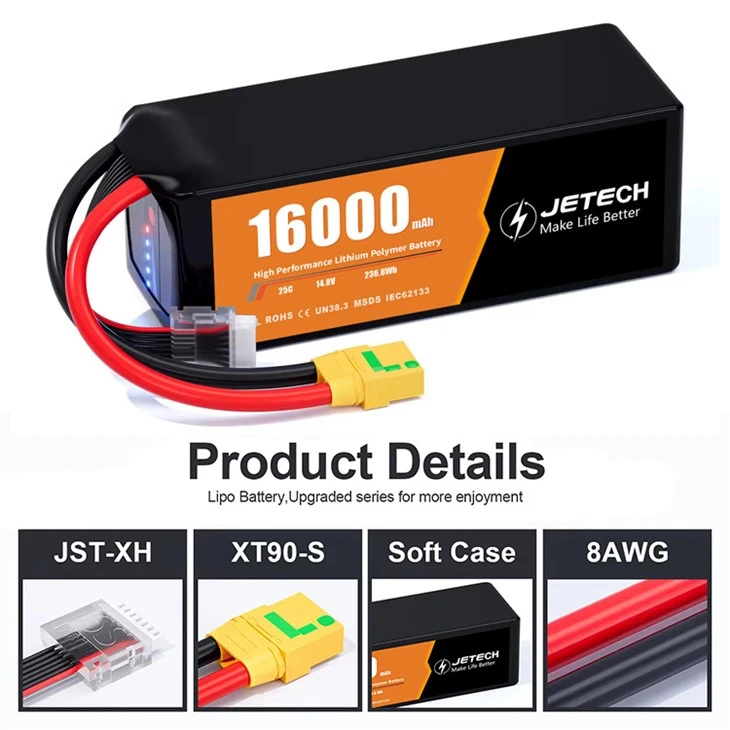
Let's take a look at some of the 4S batteries we offer. We have the 14.8V 16000mAh Lipo Battery. This battery is great for applications that require a decent amount of power over a relatively long period. With a proper discharge rate, it can keep your device running smoothly.
Another option is the 14.8V 22000mAh Lipo Battery. This one has a larger capacity, which means it can store more energy. But you also need to consider its discharge rate. If you're using it in a device that needs a sudden burst of power, you'll want to make sure the discharge rate is high enough.
We also have the 14.8V 10000mAh Lipo Battery. This battery is more compact and might be a good choice for smaller devices or applications where weight is a concern. Again, the discharge rate will determine how well it can power your device.
When choosing a 4S battery based on its discharge rate, you need to match it with the power requirements of your device. If your device needs a continuous high - power output, you'll want a battery with a high C rating. For example, if your device needs 50A of current and you have a 10000mAh (or 10Ah) battery, you'll need at least a 5C discharge rate (since 5 * 10A = 50A).
It's also important to note that the discharge rate isn't the only thing to consider. You also need to look at the battery's capacity, its internal resistance, and its overall quality. A battery with a high discharge rate but poor internal resistance might heat up quickly and lose its efficiency over time.
The temperature can also affect the discharge rate. In cold temperatures, the chemical reactions inside the battery slow down, which can reduce the effective discharge rate. So, if you're using your 4S battery in cold environments, you might need to take this into account and choose a battery that can still perform well under such conditions.
Another aspect is the battery's lifespan. A battery that's constantly discharged at a very high rate might have a shorter lifespan compared to one that's used within its recommended discharge rate. So, it's a balance between getting the power you need and making sure the battery lasts as long as possible.
We test all our 4S batteries thoroughly to ensure that they meet the specified discharge rates. Our quality control team checks the batteries under different conditions to make sure they can deliver the promised performance. We also provide detailed specifications for each battery, so you can easily compare and choose the one that's right for you.
If you're still not sure which 4S battery is the best fit for your needs, don't hesitate to reach out. We're here to help you make the right choice. Whether you're a hobbyist building your own drone or a professional in the industry, we can offer you expert advice on the discharge rate and other important factors of our 4S batteries.
We understand that every application is unique, and that's why we have a variety of 4S batteries with different capacities and discharge rates. So, if you're in the market for a 4S battery, take a look at our products. You can find more information about our 14.8V 16000mAh Lipo Battery, 14.8V 22000mAh Lipo Battery, and 14.8V 10000mAh Lipo Battery on our website.
If you have any questions or want to discuss your specific requirements, feel free to contact us. We're always happy to talk about our 4S batteries and help you find the perfect one for your project. Let's work together to get you the best 4S battery solution!
References:
- "Battery Technology Handbook"
- Industry reports on lithium - polymer batteries


