










Hey there! As a 4S battery supplier, I've spent a ton of time dealing with these power - packed little guys. And one question that comes up a lot is, "What is the internal resistance of a 4S battery?" Let's dig into it.
First off, let's quickly understand what a 4S battery is. A 4S battery is a lithium - polymer (LiPo) battery pack made up of four individual cells connected in series. Each LiPo cell typically has a nominal voltage of around 3.7V. So, when you connect four of them in series, you get a nominal voltage of 4 * 3.7V = 14.8V. These batteries are super popular in various applications, especially in drones, RC vehicles, and some high - power portable devices.
Now, let's talk about internal resistance. The internal resistance of a battery is like a hidden hurdle inside the battery itself. It's the resistance that the current encounters when it flows within the battery. You can think of it as a kind of "friction" that the electrons have to overcome while moving through the battery's components, like the electrodes and the electrolyte.
Why does internal resistance matter? Well, it has a huge impact on the battery's performance. A high internal resistance means that more energy is wasted as heat when the battery is discharging. This not only reduces the overall efficiency of the battery but also can cause the battery to heat up, which can be a safety concern. On the other hand, a low internal resistance allows the battery to deliver power more efficiently, with less energy loss and less heating.
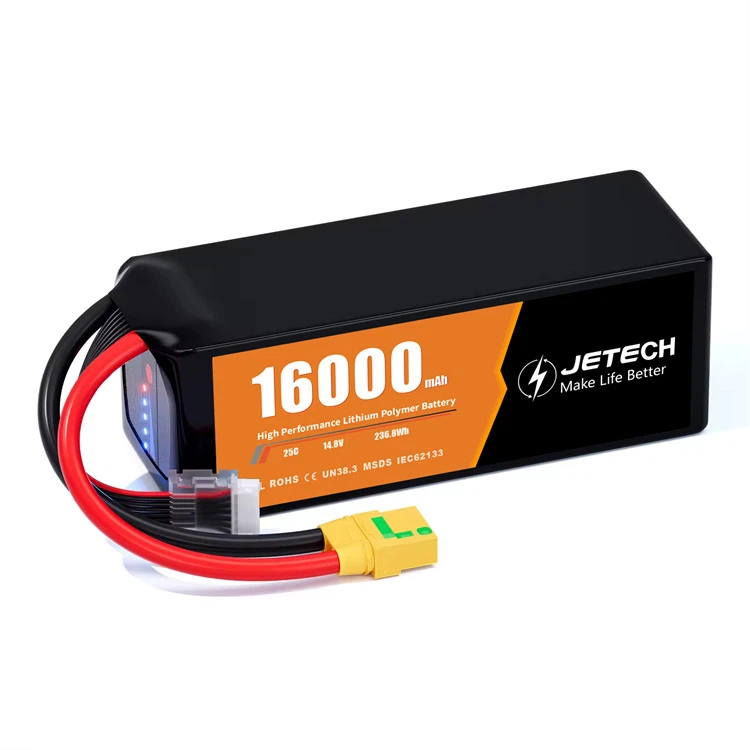

So, what's the typical internal resistance of a 4S battery? It can vary quite a bit depending on several factors. One of the main factors is the battery's capacity. For example, a 14.8V 10000mAh Lipo Battery might have a different internal resistance compared to a 14.8V 16000mAh Lipo Battery or a 14.8V 22000mAh Lipo Battery. Generally, larger capacity batteries tend to have lower internal resistance because they have more material available for the current to flow through.
Another factor is the battery's state of charge (SOC). When a battery is fully charged, its internal resistance is usually at its lowest. As the battery discharges, the internal resistance gradually increases. This is because the chemical reactions inside the battery change as the charge level drops, and these changes can affect the conductivity of the battery's components.
The age and usage history of the battery also play a role. Over time, as a battery goes through multiple charge - discharge cycles, its internal resistance can increase. This is due to things like the degradation of the electrodes and the electrolyte. So, an older battery or one that has been used heavily is likely to have a higher internal resistance than a brand - new, lightly - used battery.
Temperature is yet another important factor. Batteries perform best within a certain temperature range. When the temperature is too low, the internal resistance of the battery increases significantly. This is because the chemical reactions inside the battery slow down at low temperatures, making it harder for the current to flow. On the other hand, extremely high temperatures can also cause problems. While the internal resistance might be lower at high temperatures initially, prolonged exposure to high heat can damage the battery and lead to a permanent increase in internal resistance.
Measuring the internal resistance of a 4S battery isn't the easiest thing in the world, but it can be done. There are specialized battery testers available that can measure internal resistance. These testers work by applying a small load to the battery and measuring the voltage drop across the battery terminals. Using Ohm's law (V = IR), the internal resistance can be calculated.
As a 4S battery supplier, I always make sure to test the internal resistance of the batteries we offer. This helps us ensure that our customers are getting high - quality batteries that will perform well in their applications. We also provide detailed specifications about the internal resistance of each battery model on our product pages, so customers can make an informed decision.
If you're in the market for a 4S battery, it's important to consider the internal resistance. For applications that require high - power output, like racing drones or high - speed RC cars, you'll want a battery with a low internal resistance. This will allow the battery to deliver power quickly and efficiently, giving your device the performance it needs.
On the other hand, if you're using the battery in a less demanding application, like a small, slow - flying drone or a low - power portable device, a battery with a slightly higher internal resistance might be okay. But even in these cases, it's still a good idea to choose a battery with a reasonable internal resistance to ensure long - term reliability and performance.
In conclusion, the internal resistance of a 4S battery is a crucial factor that affects its performance, efficiency, and safety. It's influenced by many factors, including capacity, state of charge, age, usage history, and temperature. As a supplier, I'm committed to providing high - quality 4S batteries with low internal resistance. If you're interested in purchasing 4S batteries for your project, feel free to reach out to us for more information and to discuss your specific requirements. We're here to help you find the perfect battery solution for your needs.
References
- Battery Technology Handbook, various editions
- Journal of Power Sources articles on LiPo battery characteristics


